Google Ads for Small Business: A Starter Guide That Actually Costs Less Than You Think
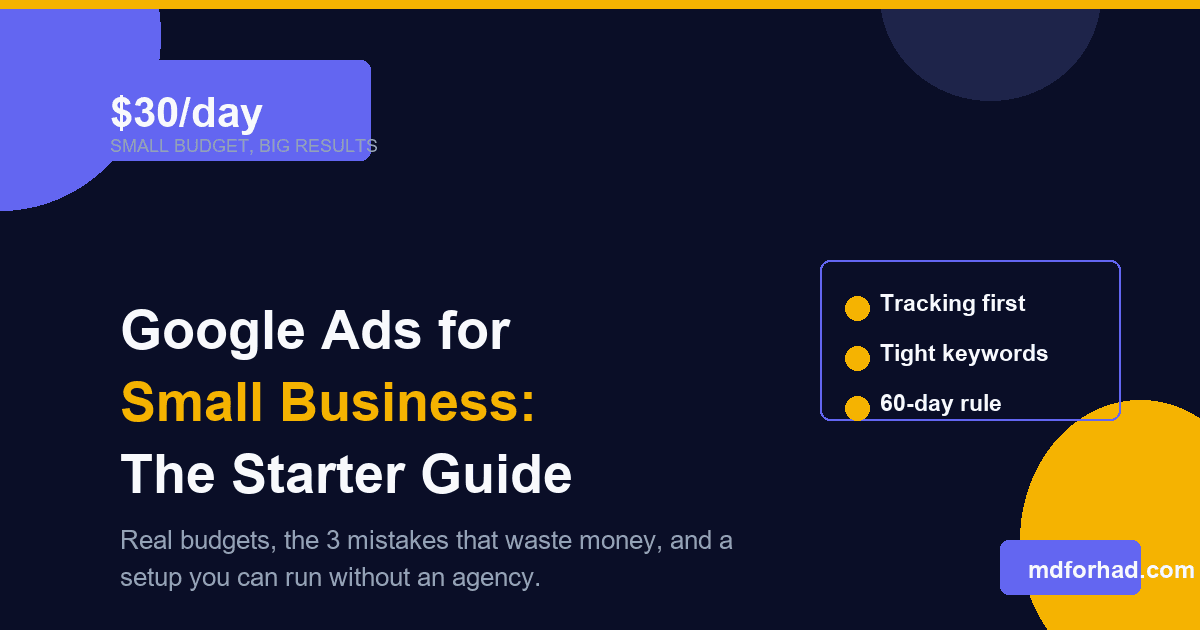
Most small business owners I talk to have the same fear. They hear "Google Ads" and picture money disappearing into a machine they don't understand. They try once, watch the budget vanish, and conclude that ads are only for big companies with deep pockets.
Here's the thing: Google Ads is genuinely one of the few marketing channels where a small budget can beat a big competitor. A $30-a-day local plumber in a small town can outrank a national chain. I've seen it happen, I've done it for clients. But it only works when you respect the fundamentals, which is exactly what this guide covers.
Does Google Ads work for small businesses?
Yes, but not in the way most people expect. It won't magically fix a bad offer, and it won't save a business that has no idea who its customer is. What it does well is put you in front of people who are already looking for what you sell, at the exact moment they're looking.
For a small business, that's the entire game. You skip the slow process of building brand awareness and go straight to the person typing "how much does roof repair cost" or "best dentist near me" right now. The click is expensive sometimes, but the intent behind it is worth more than ten cold social media impressions.
The businesses that fail with Google Ads usually fail because of how they set it up, not because the platform is broken. Three mistakes explain most failures:
- No conversion tracking. They never installed it, so they're literally flying blind. The account looks fine, the money drains, and nobody knows which keyword actually brought the customer.
- Too many keywords. A small business launches with 200 keywords and a $500 budget. Google spreads the money so thin that nothing learns, nothing converts, and at least a third of the budget pays for clicks that were never going to buy.
- Sending everyone to the homepage. A plumber running ads for "emergency pipe repair" sends people to a general homepage. Cool. The visitor has to hunt for the offer they clicked on, and most of them simply leave. A dedicated page that matches the ad converts twice as well.
If you're nodding along because your first attempt did all three, you're not bad at business. You just ran an unguided experiment. Let's fix it.
What a realistic small business budget looks like
There is no universal minimum, but there's a realistic starting range. For most local and service businesses, I recommend starting between $30 and $50 per day, which is roughly $900 to $1,500 per month. That's enough to gather real data without gambling your rent money.
Here's why that range works: in a typical local market, your click will cost $3 to $7. At $40 per day you're getting roughly 6 to 13 clicks daily, or 180 to 390 clicks a month. With a decent landing page converting at 3% to 5%, that's somewhere between 5 and 19 leads. If a single job or sale is worth $500 to $2,000, the math closes quickly.
If $30 a day is still too much, you can start at $15 to $20 a day. You'll learn slower and the numbers will be noisier, but the groundwork will be the same. Just remember one rule: give the campaign at least 60 days. Week two performance is never the real performance, and the single biggest small business mistake is quitting in week three.
Keyword strategy: less is genuinely more
The most underrated skill in small business advertising is choosing what not to bid on. Here's the frame I use:
- Start with 10 to 20 tight keywords, not hundreds. Every keyword should describe what you actually sell, in your actual service area. "Dentist Mississauga" beats "dentist" every time, and it costs a fraction.
- Use phrase and exact match first, skip broad match until you have data. Broad match in a new account is a donation to Google's suggestions.
- Add negative keywords immediately. If you don't repair iPhones, add "repair" as a negative before the campaign spends a dollar on those searches. This one step routinely saves 20% to 30% of wasted spend.
- Let the account tell you where to expand. After a month, look at the search terms report. The searches that converted become your new exact keywords. The ones that didn't go on the negative list.
That last point is the whole strategy in one sentence: run tight, read the search terms report, tighten more. Rinse and repeat.
The cheap advantage small businesses have
Big brands burn money chasing brand keywords and generic terms. Small businesses can be surgical. You can target your actual town, your actual street radius, your actual niche. Google Ads lets you draw a radius around your location and say "only show my ad within 10 miles." A national chain can't do that without splitting its budget a thousand ways.
Local businesses also win on landing pages. A chain sends you to its corporate site. A local business can build one page that says "we're the ones you called, here's our price, here's our number, here's why locals choose us." That page will convert at 2x or 3x the corporate page next to it in the results.
Use these advantages. They're free, and they're the reason a $1,000 local budget frequently beats a $50,000 national one.
What to never do with a small budget
I keep a mental list of the moves that reliably kill small accounts, so here's that list:
- Don't run "smart" campaigns you don't understand. Performance Max and smart bidding are tempting because they're one click, but on day one with no data they just spend. Start with a simple search campaign where every keyword is visible to you.
- Don't put display ads in the same campaign. Display clicks are cheap and useless for most local businesses. Keep search and display separated, or skip display entirely.
- Don't change everything weekly. Pause losers, sure, but don't rebuild the campaign. The algorithm needs consistency to learn. I've seen owners "fix" their account so often that it never left the learning phase.
- Don't ignore your phone number. If you're a service business, call extensions, click-to-call ads, and a visible number on the landing page will double your lead flow from the same budget. Small detail, huge effect.
Your first 90 days, week by week
Here's the exact sequence I use with new small business clients. Follow the order and the intent, not blindly the dates.
- Week 1: Foundations. Conversion tracking installed (calls and form submits), 10-20 keywords picked, one dedicated landing page live, negatives in place.
- Week 2: Launch. One search campaign, one ad group to start. $30 to $50 per day. Then touch nothing for at least a week, except pause anything that's clearly absurd.
- Week 3-4: Read. Study the search terms report every 3 to 4 days. Kill the junk searches, add converts as exact keywords, write a second ad to test a different headline.
- Week 5-8: Scale what works. Raise the budget on the winning ad group by 10% to 20% a week. Add one adjacent service keyword cluster. Test the call extension if you haven't.
- Week 9-12: Expand. Only now consider a second campaign, a smart campaign, or Display, now that the search account has a proven baseline.
That's it. That's the framework. It's not flashy, and it's most of what a good agency does, minus the jargon and the 12-page monthly report.
When you should just hire someone
Not everyone should do this themselves. If you're a doctor, a contractor, or a restaurant owner whose week is already full, your time is the real cost. Managing an account properly is four to six hours a month of attention once it's stable, more at the start. If that time would be better spent doing the thing you bill for, hand it off.
But if you're willing to learn and follow a process for 90 days, a small account is very much a DIY project. Start tight, track everything, read the search terms, and scale slowly. You'll know more after three months of doing it than most people ever learn about their own marketing.
And if you'd rather skip the trial and error, that's exactly what I do for a living. I've managed over five million dollars in ad spend across Google and Meta, and I'll tell you honestly whether ads make sense for your business on a free call, no pitch required.
Md Forhad
Performance Marketer
Want to Implement These Strategies?
Let's discuss how I can help you build a high-performing Google Ads account.